The Steakman Guides · No. 01
Sous Vide
Steak.
Edge to edge, wall to wall, the exact doneness you asked for. No grey band. No guessing. No standing over a pan praying. Then sixty seconds of violence at the end to give it a crust.
The Short Answer
Set the bath to 130°F (54°C) for medium-rare. Cook a 1.5-inch steak for 2 to 3 hours. Dry it completely, then sear it in a screaming cast iron skillet for 45 to 60 seconds a side. Bath temperature is the final internal temperature — there is no carryover, no pull temp, and no way to overshoot.
Every number below was cooked on an Anova Precision Cooker — the unit clamped to the pot in our kitchen for years. Steakman is reader-supported; if you buy through our links we may earn a commission at no cost to you. Full disclosure.
The Physics
What Sous Vide Actually Does To A Steak.
Put a steak in a 500°F pan and you are running a race. Heat enters from the outside and marches inward, and your job is to stop it at the exact instant the center hits your number. You never win cleanly. By the time the middle is 130°F, the quarter inch under the crust is 145°F and the quarter inch under that is 160°F. That grey band is not a cosmetic problem. It is overcooked meat, and you paid for it.
Sous vide removes the race. You put the steak in water held at the temperature you want the meat to finish at, and you wait. The steak climbs to that temperature and then stops, because the water has nowhere hotter to take it. Thermodynamics does the work a thermometer and a nervous cook used to do. Ten minutes late? Doesn't matter. Forty minutes late? Still doesn't matter. The steak is exactly as done as it was an hour ago.
What you lose is the crust — water tops out at 212°F, and the Maillard reaction, the browning that makes a steak taste like a steak, does not get going until around 300°F. So the method is two halves. Water owns the inside. Fire owns the outside. Neither one is allowed to touch the other's job.
Sous vide is not a shortcut. It is a way of removing every variable except the one you actually control: heat, held exactly.
Temperature
Bath Temp Is Final Temp.
This is the part people get wrong, and it is worth being blunt about. Every other page on this site lists a pull temp — the number you take a steak off the fire at, five to ten degrees below your target, because carryover heat finishes the job. Sous vide has no carryover. There is no gradient to equalize. The number you dial in is the number you eat.
| Doneness | Bath Temp | Celsius | What You Get |
|---|---|---|---|
| Rare | 120–125°F | 49–52°C | Soft, deeply red, barely set. Fat has not rendered. |
| Medium-RarePick | 129–131°F | 54–55°C | Red center, juices run, fat starts to give. The number we cook. |
| Medium | 135–137°F | 57–58°C | Pink, firmer bite, more rendered fat. Best for fatty cuts. |
| Medium-Well | 142–145°F | 61–63°C | Faint pink. Meaningful moisture loss starts here. |
| Well Done | 152–156°F | 67–69°C | No pink. Sous vide keeps it edible. It cannot make it great. |
One caveat worth knowing: fat renders with time and temperature, and a fatty cut at 130°F never gets hot enough to fully render its intramuscular fat the way a hard grill sear does. On a heavily marbled ribeye or a wagyu-grade steak, 133–135°F often eats better than 130°F. On a lean filet, stay at 129–130°F.
Time
How Long. By Thickness, Not By Feel.
Time in a sous vide bath does one thing: it gets the center of the steak up to the water temperature. That depends on thickness, and on nothing else. A 12-ounce steak and a 24-ounce steak of the same thickness take exactly the same time. Weight is irrelevant. Measure the thick part with a ruler and read the row.
| Thickness | Minimum | Sweet Spot | Maximum |
|---|---|---|---|
| 1" | 1 hr | 1–2 hrs | 3 hrs |
| 1.25" | 1 hr 30 min | 1.5–2.5 hrs | 3.5 hrs |
| 1.5" | 2 hrs | 2–3 hrs | 4 hrs |
| 1.75" | 2 hr 30 min | 2.5–3.5 hrs | 4 hrs |
| 2" | 3 hrs | 3–4 hrs | 4.5 hrs |
| 2.5" (tomahawk) | 4 hr 30 min | 4.5–5.5 hrs | 6 hrs |
Frozen? Add 50%.
Straight from the freezer, no thawing, no compromise. A frozen 1.5-inch steak needs about three hours instead of two. This alone justifies the machine.
The Real Limit.
You cannot overcook past temperature — but you can over-tenderize. Past four hours the texture starts sliding toward pot roast. Tender is the goal. Mushy is a failure.
The Arsenal
The Machine. And What Makes One Good.
An immersion circulator is a heating element, a pump, and a thermostat on a stick. That is the whole product. What separates a good one from a bad one is whether it holds its number without drifting, whether it moves enough water to keep the whole pot even, and whether it clamps to the side of a pot without wobbling into it. Everything else is a spec sheet.
The Steakman Pick
Anova Precision Cooker
This is the unit we own and the one every temperature on this page was cooked on. It holds its set point without wandering, the pump keeps a 12-quart pot genuinely even corner to corner, and the clamp bites hard enough that it stays put on a thin stockpot rim. The app is useful for exactly one thing — telling you the bath is up to temp while you are in another room — and it works without your phone if you never open it. It has never failed us, and it costs less than one dinner for two at a steakhouse.
- Holds the set temperature within a fraction of a degree across a multi-hour cook
- Circulation strong enough for a 12-quart pot — no cold pockets, no flipping bags
- Adjustable clamp that fits a stockpot rim or a polycarbonate tub
- App and Wi-Fi control, plus full manual control on the unit itself
- Pays for itself the first time it saves a $40 ribeye
The Rest Of The Kit.
A Big Pot Or A Tub
12 quarts minimum. A plastic tub with a cut lid is better for long cooks, but a stockpot works and you already own one.
Zip-Top Freezer Bags
Freezer grade, not sandwich grade. A vacuum sealer is nice, not necessary — water displacement gets the air out just as well.
Cast Iron
The sear is the other half of this recipe. A 12-inch skillet holds heat better than any nonstick pan ever will.
An Instant-Read Thermometer
Not for the bath — for verifying the bath. Trust, then confirm, at least the first few cooks.
That is the entire list. Pot, bag, circulator, iron. The Anova Precision Cookeris the only piece you probably don't already have, and it is the only one that matters.
See the full arsenalThe Method
Nine Steps. Every Time.
Salt It First
Season with coarse kosher salt on every surface, edges included. Do it before the bag, not after. Salt inside the bag for a short cook seasons the meat; for cooks past four hours it can push the texture toward ham, so on long cooks salt after the bath instead.
Bag It
Vacuum sealer if you own one. If you don't, a zip-top freezer bag and the water displacement method work exactly as well: lower the open bag into the water and let the pressure squeeze the air out, then seal it above the waterline. No air means full contact. Full contact means even heat.
Skip the Butter
Butter in the bag does not baste the steak. It dilutes the beef fat and pulls flavor compounds off the meat and into the liquid you throw away. Aromatics — thyme, rosemary, smashed garlic — are fine and welcome. Save the butter for the pan.
Set the Bath
Clamp the circulator to a stockpot or a plastic tub, fill above the minimum line, set your temperature, and let it come up before the steak goes in. Preheating matters — dropping cold meat into a bath that is still climbing is how you lose the precision you bought.
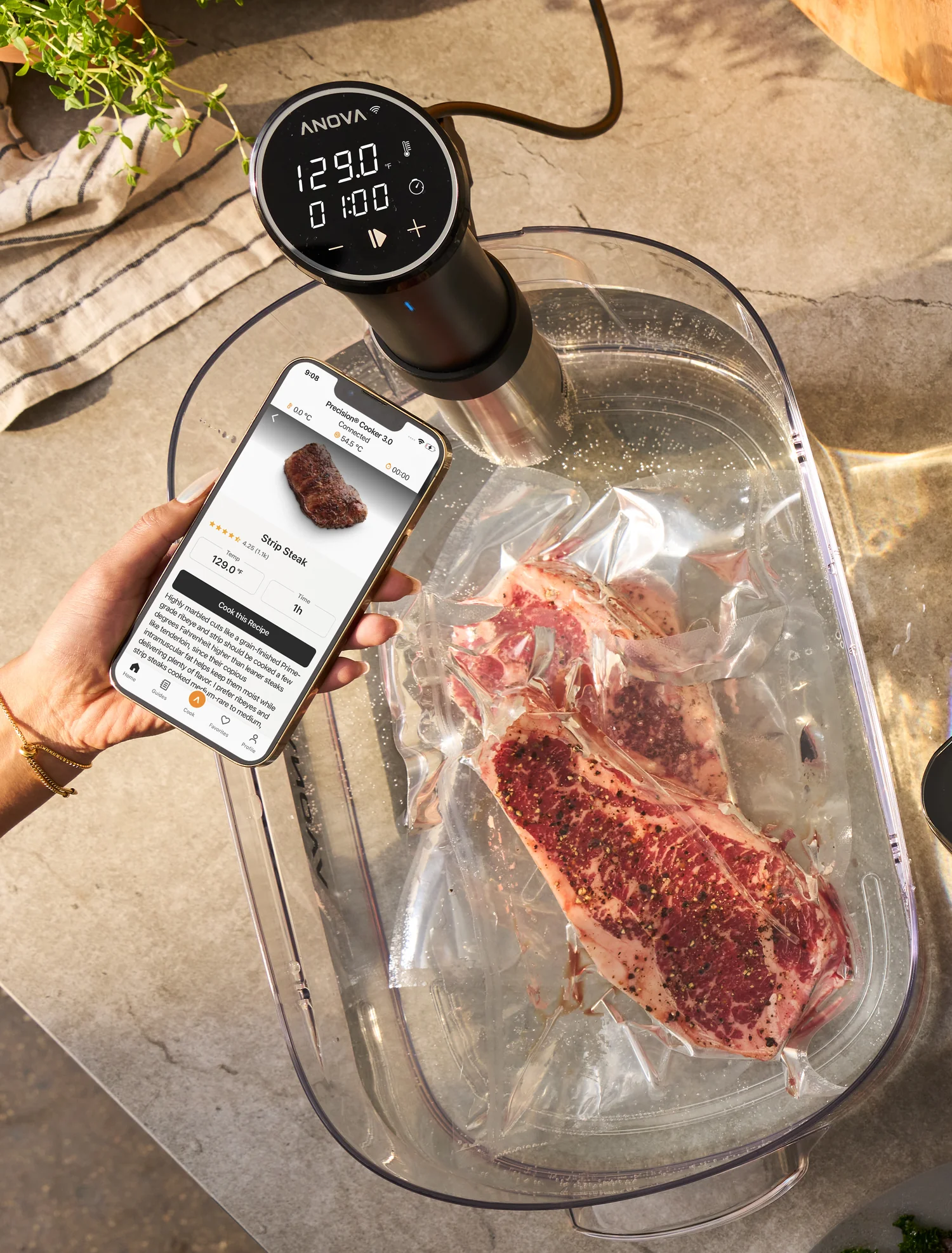
We run an Anova Precision Cooker clamped to a 12-quart stockpot. It hits 130°F in about eight minutes and does not move off it for the rest of the afternoon.
Cook to Time, Not to Doneness
The steak cannot overcook past the bath temperature. Time is only about getting the center there and holding it. Use the chart. When the minimum passes, you have a window of a couple of hours where nothing bad happens.
Dry It Like You Mean It
Out of the bag, onto paper towels. Blot every face, both edges. Then let it sit uncovered for five to ten minutes. Wet steak steams. Steam is the enemy of crust. This step costs nothing and decides everything.
Screaming Heat
Cast iron over high heat until the oil shimmers and just barely smokes, or a grill run as hot as it will go. A neutral high-smoke-point oil — grapeseed, avocado, refined canola. Not olive oil. Not butter yet.
Sear 45–60 Seconds a Side
That is the whole sear. The inside is already finished — every second in the pan is a second the perfect edge-to-edge center starts turning grey. Press it down for contact, flip once, hit the fat cap on its edge with tongs, and get out.
Butter at the Buzzer, Then Serve
Kill the heat, drop in butter, garlic, and rosemary, and spoon it over for fifteen seconds. Then plate it and cut. No resting required — resting is for redistributing juices after a violent temperature gradient, and sous vide never created one.
The Finish
The Sear Is Where People Blow It.
Three hours of perfect, patient, invisible work can be destroyed in ninety seconds. Here is how it happens: the steak comes out of the bag still wet, it goes into a pan that is merely hot instead of dangerous, and it sits there for three minutes a side while the cook waits for a crust that will not come — because the surface water has to boil off before browning can even start. By the time it browns, the outer half inch is medium-well and the grey band you spent three hours avoiding is right back where it always was.
Fix it with three decisions. Dry the steak completely — paper towels on every face, then five to ten minutes uncovered on a rack. Some cooks put it in the freezer for ten minutes; a slightly chilled surface buys you a few extra seconds of sear before the inside notices. Get the pan genuinely smoking — cast iron on high until a drop of oil shimmers and the first wisp comes off it. Then get out fast — 45 to 60 seconds a side, one flip, tongs to stand it on the fat cap for another 20 seconds, done.
Butter goes in at the end, off heat, with garlic and rosemary, and gets spooned over for fifteen seconds. Not at the start — milk solids burn long before a steak crusts.
And do not rest it. Resting exists to calm a steak that was cooked violently. This one wasn't. Cut it immediately.
The Cuts
What To Put In The Bag.
Sous vide rewards thickness. The thicker the steak, the bigger the grey band you are eliminating, and the more the method earns its three hours. Under an inch, honestly, just use a hot pan. At an inch and a half and up, this is the best tool in the kitchen.
Ribeye
133°FMarbling needs a few extra degrees to render. Run it warmer than the rest.
See the cut guide →Filet Mignon
129°FLean and unforgiving on a grill. Sous vide makes it foolproof.
See the cut guide →NY Strip
130°FThe reference cut. 130°F, two hours, hard sear, no notes.
See the cut guide →Tomahawk
131°FToo thick to grill evenly. This is the only method that nails it.
See the cut guide →Chuck Eye
131°FCheap cut, four hours, tastes like a ribeye that costs triple.
See the cut guide →Top Sirloin
130°FLean and often tough. Time in the bath fixes both problems.
See the cut guide →The Question Everyone Asks
Is 130°F For Three Hours Safe?
Yes — and the reason is worth understanding, because the 165°F number stamped on every consumer food-safety chart is an instant-kill temperature, not the only safe one. Pasteurization is temperature and time working together. Hotter kills faster; cooler kills slower; both get there.
For beef, a 1.5-inch steak held at 131°F pasteurizes in roughly three and a half hours. At 135°F, about two and a half. At 140°F, under two. So a long cook at medium-rare is not a compromise on safety — it is a slower route to the same destination.
And for a shorter cook, whole-muscle beef carries its risk on the outside surface, not through the interior. That surface spends 45 to 60 seconds a side in a 500°F pan at the end. This is the same logic that makes a medium-rare steak safe off any grill in America.
Two rules stand regardless. Never hold food between 40°F and 130°F for more than four hours — that is the danger zone, and a bath set below 130°F is inside it. And ground beef, mechanically tenderized steak, or anything with the surface pushed into the middle needs a full pasteurization hold, not a sear.
The Steakman Rule
130°F, two to three hours, hard sear. If you want a pasteurized hold, give it four hours at 131°F and lose nothing.
Head To Head
Sous Vide vs. Reverse Sear vs. Straight Fire.
| Sous Vide | Reverse Sear | Hot & Fast | |
|---|---|---|---|
| Precision | Absolute | Very good | Depends on you |
| Total time | 2–4 hrs | 45–60 min | 15 min |
| Hands-on time | 10 min | 25 min | 15 min |
| Grey band | None | Thin | Real |
| Crust potential | Good | Best | Good |
| Margin for error | Enormous | Moderate | None |
| Best for | Thick cuts, guests, repeatability | Weeknights with a thermometer | Thin cuts, skirt, flank |
None of these is wrong. But if you are cooking a two-inch ribeye for people you want to impress, there is exactly one method that will not betray you at the last minute. That is the whole pitch for the Anova Precision Cooker: it turns the most stressful forty minutes of a dinner party into a timer you already set three hours ago.
Don't
Six Ways To Ruin It.
Searing a wet steak
Water must boil off before browning starts. Blot, then air-dry ten minutes. Non-negotiable.
Searing too long
The inside is already done. Every second past sixty is a second of grey band coming back.
Butter in the bag
It pulls flavor out of the beef and into liquid you throw away. Butter belongs in the pan.
Cooking past four hours
Enzymes keep working. Steak becomes pot roast. Set a timer for the maximum, not just the minimum.
A floating bag
Air in the bag lifts the steak out of the water and it cooks unevenly. Displace the air or weight it down.
Cold pan, thin oil
Medium-high is not high. Use a high-smoke-point oil and wait for the first wisp of smoke.
Answers
The Sous Vide Steak FAQ.
What is the best temperature for sous vide steak?
130°F (54°C) for medium-rare. That is the number we cook and the number most steakhouses target. Sous vide bath temperature is the final internal temperature — there is no carryover to plan around — so 130°F in the water is 130°F on the plate, edge to edge. Go to 135°F for medium, 125°F for rare.
How long do you sous vide a steak?
One to two hours for a 1-inch steak, two to three hours for a 1.5-inch steak, and three to four hours for a 2-inch steak. The minimum time is however long it takes the center to reach the bath temperature; past that you have a two-hour grace window where the steak simply waits for you.
Can you overcook a steak in a sous vide?
Not in the usual sense — the steak can never exceed the water temperature. But it can go bad in a different way. Past roughly four hours, enzymes keep breaking down connective tissue and the texture drifts from steak toward pot roast. Tender is good. Mushy is not. Respect the maximum times.
Do you sear a steak before or after sous vide?
After. Always after. The crust is the last thing you build, because searing first and then bathing the steak for two hours softens the crust you just made. Some people sear briefly on both ends to kill surface bacteria before a very long cook, but for a normal steak the answer is one hard sear at the finish.
Do I need a vacuum sealer for sous vide steak?
No. A zip-top freezer bag and the water displacement method get you the same result: seal all but one corner, lower the bag into the water until the pressure forces the air out, then close the corner above the waterline. Use freezer-grade bags — sandwich bags are too thin for a multi-hour bath.
Is sous vide steak safe at 130°F?
Yes, when you hold it there. Food safety is a function of temperature and time together, not temperature alone. A 1.5-inch steak held at 131°F pasteurizes in about three and a half hours; at 135°F, about two and a half. A shorter cook at 130°F is still as safe as any medium-rare steak off a grill, because the risk on whole-muscle beef lives on the surface, and the sear handles the surface.
What is the best cut of steak for sous vide?
Thick ones. Anything 1.5 inches or more — ribeye, New York strip, filet mignon, tomahawk, porterhouse — because sous vide's whole advantage is eliminating the grey band, and thin steaks barely have one. It is also the best tool on earth for tough, cheap cuts: chuck eye, tri-tip, and top sirloin come out well above their price.
Can you sous vide a frozen steak?
Yes, straight from the freezer, no thawing. Add about 50 percent to the cook time — a frozen 1.5-inch steak needs roughly three hours instead of two. This is the single most underrated feature of a precision cooker: a steak goes from freezer to plate with no planning at all.
Should I put butter in the sous vide bag?
No. Fat in the bag dissolves flavor compounds out of the beef and into liquid you pour down the drain. It also insulates the meat slightly. Put aromatics in the bag if you like, and put the butter in the pan at the very end of the sear where it can actually do something.
Why is my sous vide steak grey and not seared?
Because it was wet. Water on the surface has to boil off before the surface can climb past 212°F, and browning does not start until roughly 300°F. Blot it dry, air-dry it uncovered for five to ten minutes, get the pan genuinely smoking, and use an oil with a high smoke point.
Sous vide vs reverse sear — which is better?
Sous vide is more precise and completely hands-off; reverse sear is faster and gives a slightly drier surface that browns more aggressively. If you want the same result every single time and want to stop watching a thermometer, sous vide wins. If you want to cook a steak in forty minutes with gear you already own, reverse sear wins.
How much water does a sous vide need?
Enough to cover the steak completely and stay between the minimum and maximum fill lines on the circulator — usually a 12-quart stockpot or a plastic tub. Cover the top with foil or a lid on cooks over two hours to cut evaporation, and use a rack or clip so the bag never floats above the waterline.
The One Piece Of Gear
Anova Precision Cooker
Every temperature, every time, every result on this page came off this machine. It is clamped to a pot in our kitchen right now. It has never given us a bad steak, and it will not give you one either — because the only way to get a bad steak out of it is to skip the sear, and now you know better.
Steakman is reader-supported. As an Amazon Associate we earn from qualifying purchases. This costs you nothing and keeps the fire lit. Affiliate disclosure.